BETTERMYND BLOG

Enrollment-based (per-student) vs. usage-based mental health models for campuses: which expands access to every student who needs it?

College counseling centers and student support teams are facing mounting pressure. According to the latest Healthy Minds Study, more than 35–40% of college students report moderate to severe mental health conditions, with rates of depression and anxiety rising.  

Yet even as needs grow, campus resources remain stretched thin. Many students never reach out for help, or they disengage quietly before finding support. Behind every unbooked session or limited program lies a hidden student—someone struggling without ever appearing in the data. 

The challenge for institutions and student affairs leaders isn’t just how to offer more services. It’s how to design systems that meet student demand in ways that align resources, budgets, and outcomes—ensuring that every dollar invested leads to real access and real care. 

For years, the industry default has been subscription-based pricing, a model that offers predictability but often limits reach. 

At BetterMynd, we took a different path. In 2017, we were founded with a usage-based pricing model with roll-over—a system designed to flex with limited or changing budgets, expand access, and connect care to the students who need it most.

Alexandria Glaize, MA

Director of Growth Marketing

BetterMynd

The enrollment-based (per-student) model: high cost, low flexibility

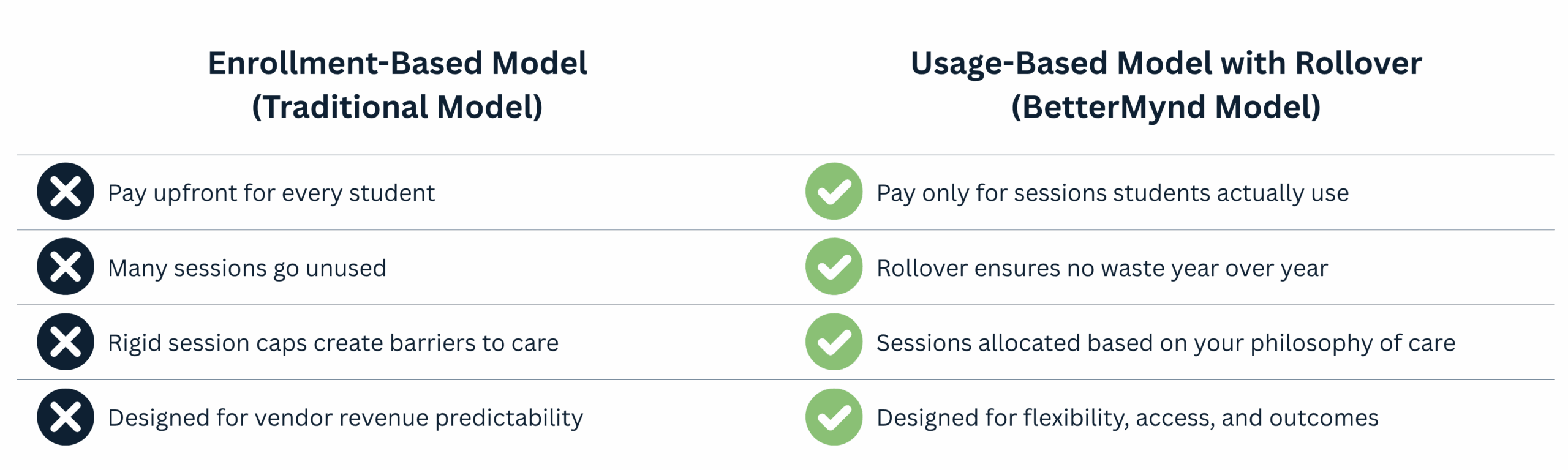
In an enrollment-based model, colleges pay a flat fee per student across the entire population, regardless of whether those students ever use the service. 

The result? Budgets are locked in early, but the reach remains narrow. The students who need support most often still don’t get it. 

The problems with enrollment-based (per-student) pricing for teletherapy: 

  • Wasted resources: The majority of purchased sessions go unused. Dollars sit idle while students in need remain unseen. 
  • Rigid caps: Once session limits are hit, students in need of more support are under-served. 
  • Budget strain: Institutions pay for capacity that benefits just a small fraction of their population. 

“When we did the math dependent on our utilization, we were spending about $600 per session. That’s just not sustainable. Furthermore, we didn’t have access to the data to understand what was actually working.”

Victoria Flores, MSW
Dean of Student Wellness and Support Services
Los Rios Community College District

The usage-based model with roll-over: built for access, resource alignment, and student success

At BetterMynd, we pioneered this model in 2017 after seeing how traditional systems left too many students out of reach—especially first-generation, commuter, and part-time learners who rarely walk into the counseling center. 

Here’s how it works: 

  1. Buy what you need, add more anytime. Institutions purchase sessions based on need and budget, scaling as demand evolves. 
  1. Align with your philosophy of care. Counseling, student affairs, or wellness staff decide how to distribute sessions—through open access, referral-based, or hybrid models. 
  1. No waste. All unused sessions roll over to the next year, ensuring every dollar continues to serve students. 

This approach gives institutions the flexibility to meet real demand—wherever students are—and ensures that budgets directly support student wellbeing and persistence. 

Why roll-over matters

Student demand doesn’t run on tidy billing cycles. Midterms, finals, and life stressors don’t reset every semester. Without roll-over, unused sessions vanish—leaving next year’s hidden students unserved. 

With roll-over, every unused session becomes a future opportunity for care—for the student who wasn’t ready this term but finds the courage next semester. 

That’s how institutions begin building systems that adapt to real student lives, not the other way around.

Proof in action: Los Rios CCD

At Los Rios Community College District, one of the largest systems in California, the results speak for themselves: 

“In our first year with BetterMynd’s usage-based model, over 2,000 students accessed care affordably and equitably. Every dollar was tied directly to sessions used by our students.” 

This model not only stretched budgets further but also connected support to a broader, more diverse segment of the student body—precisely the population student affairs leaders are striving to reach. 

Proof in action: St. John Fisher University

At St. John Fisher, the impact was just as striking: 

“100% of purchased sessions were used by students. Not one dollar was wasted.” 

This case illustrates the transparency and trust usage-based care builds with both administrators and students. When every dollar leads to real care, confidence grows. 

Why usage-based wins out

  • Flexibility: Adapts to changing student demand and institutional priorities. 
  • Transparency: Clear alignment between investment and outcomes. 
  • Sustainability: Budgets stretch further because nothing is wasted. 
  • Access: Expands reach to students who often don’t seek traditional care. 
  • Trust: A consistent, student-first model used nationwide since 2017. 

BetterMynd’s approach is grounded in three principles: alignment and flexibility, transparency, and financial sustainability—each designed to help institutions create more responsive, equitable systems of care.

The bottom line

Subscription-based care was built for predictability.
Usage-based care with roll-over was built for people—and the institutions that serve them. 

That’s why BetterMynd pioneered this model in 2017 and why it’s become the standard for affordable, equitable, and student-centered care that supports both individual wellbeing and institutional success. 

Ready to learn more?

BetterMynd partners with more than 150 colleges and universities nationwide, helping expand access while protecting budgets. 

👉 Read our full partner impact stories here.
👉 Connect with our team to see how usage-based care could work for your campus here. 

BetterMynd: Built right from the start—to reach every student and strengthen the systems that support them. 

FAQs

A: Subscription-based models charge a flat fee per student, whether they ever access care or not. This often leads to wasted dollars on unused sessions. Usage-based models, pioneered by BetterMynd in 2017, only charge for sessions students actually use—often with roll-over built in to maximize flexibility and access. 

A: Student demand for mental health care doesn’t follow a strict billing cycle. With roll-over, unused sessions carry forward, ensuring no dollars are wasted and students always have access when they need it most—whether that’s midterms, finals, or a personal crisis.

A: Usage-based care is more affordable and transparent because every dollar goes directly to sessions students actually use. Subscription models often look affordable upfront, but result in large amounts of unused capacity.

A: Usage-based models with roll-over have proven to improve access, reduce waste, and increase engagement. At St. John Fisher, for example, 100% of purchased sessions were used by students. Subscription-based models have not published equivalent utilization data tied to affordability.

A: BetterMynd pioneered the usage-based, roll-over model in 2017 and has consistently used it ever since. Today, it’s become the standard for student-centered affordability and access.

CONTACT BETTERMYND

Want to supplement or expand care on your campus?

BetterMynd’s mission is to help every campus meet individualized student mental health needs through a service-first, sustainable partnership.