From that perspective, I think private-sector partners in student mental health owe the field a few things, and they are connected.
The most important one is that we should build on what already exists. College counseling has developed research, assessment tools, professional standards, and clinical wisdom over decades. Reinventing that work in favor of a proprietary approach is rarely better for students or institutions, and usually it is just easier on the vendor.
Building on that work means being transparent about methodology and about limits — if we say something is working, we should be able to show how we know, and if there are limits to what the data can tell us, we should say so clearly. Responsible measurement includes restraint.
That matters because the field has seen too many claims presented with more confidence than the underlying method can support. Utilization gets treated as outcome. Access gets treated as continuity. Satisfaction gets treated as clinical improvement. Proprietary dashboards can make a service look measurable without making it meaningfully accountable. Those distinctions shape how institutions understand student need, how they allocate limited resources, and how they explain to students and families what kind of care is actually being provided.
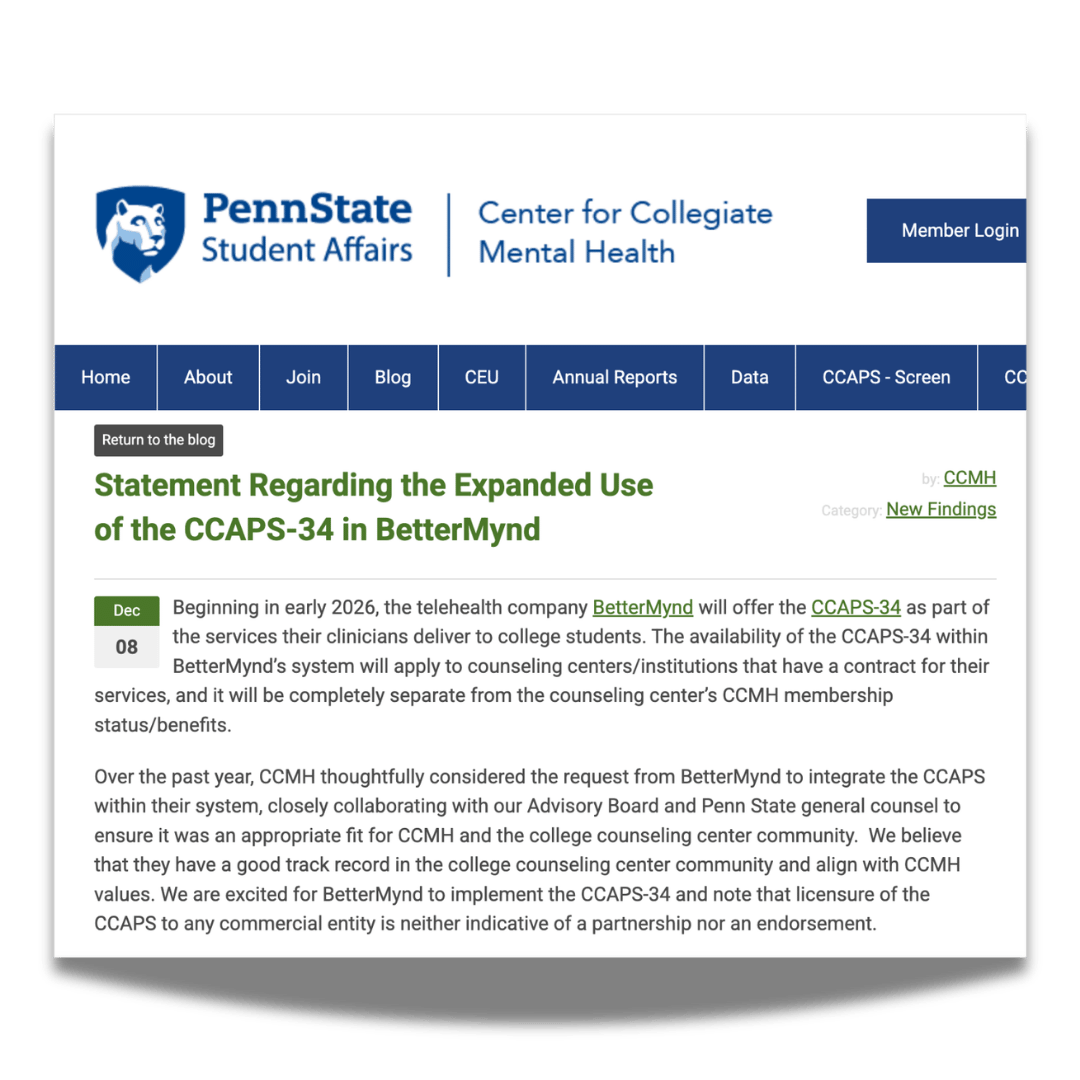
All of which is to say that private-sector partners should be accountable to the standards of the field we serve. If counseling centers are expected to examine outcomes, assess need, and make evidence-informed decisions under real operational constraints, their partners should not be held to a lower one. That means being willing to say what our tools measure and what they do not, not overstating the relationship between engagement and clinical change, and not asking institutions to accept a vendor-defined version of success when the field already has stronger ways to evaluate student distress, treatment response, and care quality.
It also means vendor partners need to be in the conversation, not adjacent to it. For a long time, it made sense for college counseling to be cautious about private-sector involvement. The field had good reasons to protect its standards, its students, and its clinical judgment. But external partners are now part of the student mental health ecosystem in a more established way. Calling vendors into the conversation is not the same as giving them a pass. It is a way of making sure they are working within the expectations, language, and accountability structures the field has already built.
None of this is especially radical. It is what college counseling has asked of itself for a long time.
The question is why private-sector partners should be exempt from the same expectations.
I do not think we should be. And I do not think the next phase of this work should be about keeping vendors outside the room until something goes wrong. It should be about inviting the right partners into the room earlier, with clearer expectations about evidence, clinical scope, data use, student privacy, and shared responsibility.
There is more to figure out.