LEADERSHIP BLOG

What We Ask of Ourselves

Kate Wolfe-Lyga, LMHC, ACS
Vice President of Clinical Operations, BetterMynd
Master of Science, Community Counseling from Syracuse University​
Former Counseling Center Director of SUNY Oswego
Former AUCCCD Board Member

Measurement, accountability, and what it means to license the CCAPS-34

There is a question every counseling center director asks at some point, often quietly and sometimes in the middle of a very practical conversation about capacity:

When a student moves from campus-based care to an external provider, what do we actually know about the care they are about to receive?

For much of my career in college counseling centers, the honest answer was: not enough.

We referred students because we needed to. A student lived out of state. A semester was ending. A waitlist was too long. A student needed an appointment sooner than the center could offer one. We made the best clinical decisions we could within the systems we had.

Those referrals were often appropriate. They were also often incomplete in a way the field has had to live with for too long.

The campus provider had context: what brought the student in, what patterns had emerged, what had helped, what had not, and what level of concern the student’s presentation raised. But once care moved outside the counseling center, much of that context became harder to carry forward. Sure, we may have sent records, but the receiving provider completed their own intake, used their own assessment tools, and built their own case conceptualization. Too often, the student became the only bridge between two systems of care.

That is a difficult role to ask a student to play, especially when the reason they are seeking care is that they are already struggling.

Online therapy has helped address a very real problem in higher education: access. When a student needs care and a campus counseling center is at capacity, access matters. It matters clinically, operationally, and ethically.

But access and continuity are not the same thing.

That distinction has become increasingly important to me over the course of my work in mental health and human services, including a decade in college counseling centers and more than three years now on the private-sector side of this work. Expanding capacity does not automatically answer the question of how well care travels across settings. It does not automatically give a counseling center a clear understanding of whether students receiving external support are improving, what kinds of concerns they are presenting with, or how those concerns compare with the students seen on campus.

That is where measurement matters. And it is why BetterMynd’s exclusive license to use the CCAPS-34 matters.

Why shared measurement matters

Most counseling center directors are not asking for more data for its own sake. They are asking for clinically meaningful information that helps them understand student need, evaluate service design, and make responsible decisions about care.

For years, one of the challenges with external and online care has been that the measurement systems did not always align with the systems used in college counseling. Many providers use validated tools such as the PHQ-9 or GAD-7. Those instruments have value but are normed on a more general group. They also do not capture the full range of concerns that college counseling centers routinely assess in student populations.

College student mental health is not only a question of depression and anxiety symptoms. It often includes academic distress, social disconnection, eating concerns and other patterns that matter in the college context. Counseling centers have spent decades building assessment practices that reflect that complexity.

The question, then, is not simply whether an external provider measures outcomes. The more useful question is whether the measurement is meaningful to the campus systems that are trying to understand and support their students.

Shared measurement creates a common clinical language. It allows campus leaders and external partners to look at student need through a similar lens. It helps move the conversation from utilization alone — how many students attended sessions — toward clinical presentation, change over time, and population-level patterns.

That distinction matters.

Session counts can tell us whether students are using a service. They do not tell us enough about who those students are clinically, what level of distress they are experiencing, or whether the care being provided is associated with meaningful change.

“Most counseling center directors are not asking for more data for its own sake. They are asking for clinically meaningful information that helps them understand student need, evaluate service design, and make responsible decisions about care.”

Building on the field’s existing infrastructure

One of the things I have always valued about college counseling is that the field has not waited for someone else to define its standards. Counseling centers have built a substantial research and assessment infrastructure over time, and much of that work has been led through the Center for Collegiate Mental Health at Penn State.

CCMH is a practice-research network of more than 850 college and university counseling centers. Its work has helped the field better understand student distress, counseling center utilization, clinical outcomes, and the operational realities of providing mental health care in higher education.

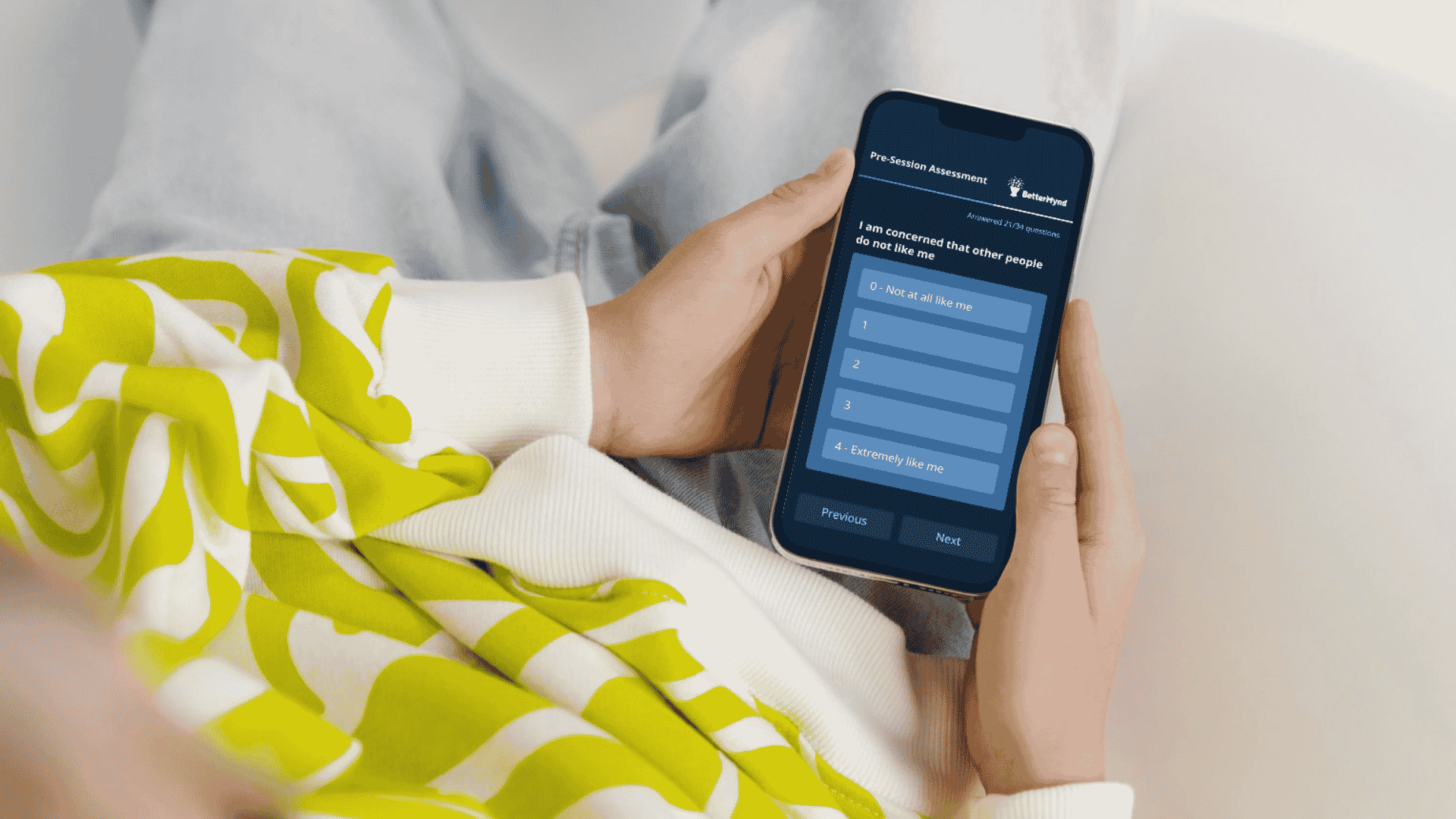
The Counseling Center Assessment of Psychological Symptoms, or CCAPS, is central to that work. The CCAPS-34 is a 34-item instrument designed specifically for college student mental health. It measures seven subscales related to psychological symptoms and distress and includes a Distress Index. Normed on data from close to half a million students, it can be completed in only a few minutes.It gives clinicians and centers a more contextually relevant view of student distress than many general-population measures alone can provide.

For many counseling centers, the CCAPS is not an abstract research tool. It is part of everyday clinical and administrative practice. It helps inform treatment, aggregate reporting, quality improvement, and program evaluation.

That is why BetterMynd’s exclusive licensure of the CCAPS-34 matters.

It is not important because it gives us a new proprietary metric. It is important because it does the opposite. It allows an online therapy partner to use an assessment framework the college counseling field already knows, has helped build, and can interpret.

That distinction is important. The goal should not be to invent parallel systems simply because we can. The goal should be to align with the systems that already have credibility, utility, and clinical relevance in higher education.

For me, that is the center of the story. Not that BetterMynd found a new way to talk about outcomes, but that we agreed to be measured through the same clinical language counseling centers have used to understand their own students.

What it took to get here

When I joined BetterMynd, one of the first questions I cared about was how we measured student need and clinical change.

Not whether we measured it at all. Any responsible clinical organization should be asking that question. The issue was whether our measurement approach aligned with the field we were serving.

For college counseling, the obvious answer was the CCAPS-34. But adopting the CCAPS was not simply a matter of deciding we wanted to use it. CCMH needed to understand how the tool would be implemented, how clinicians would be trained, how data would be handled, and how the use of the instrument would support responsible clinical care for students.

That process matters because measurement is not just a technical decision. It is a clinical and ethical one.

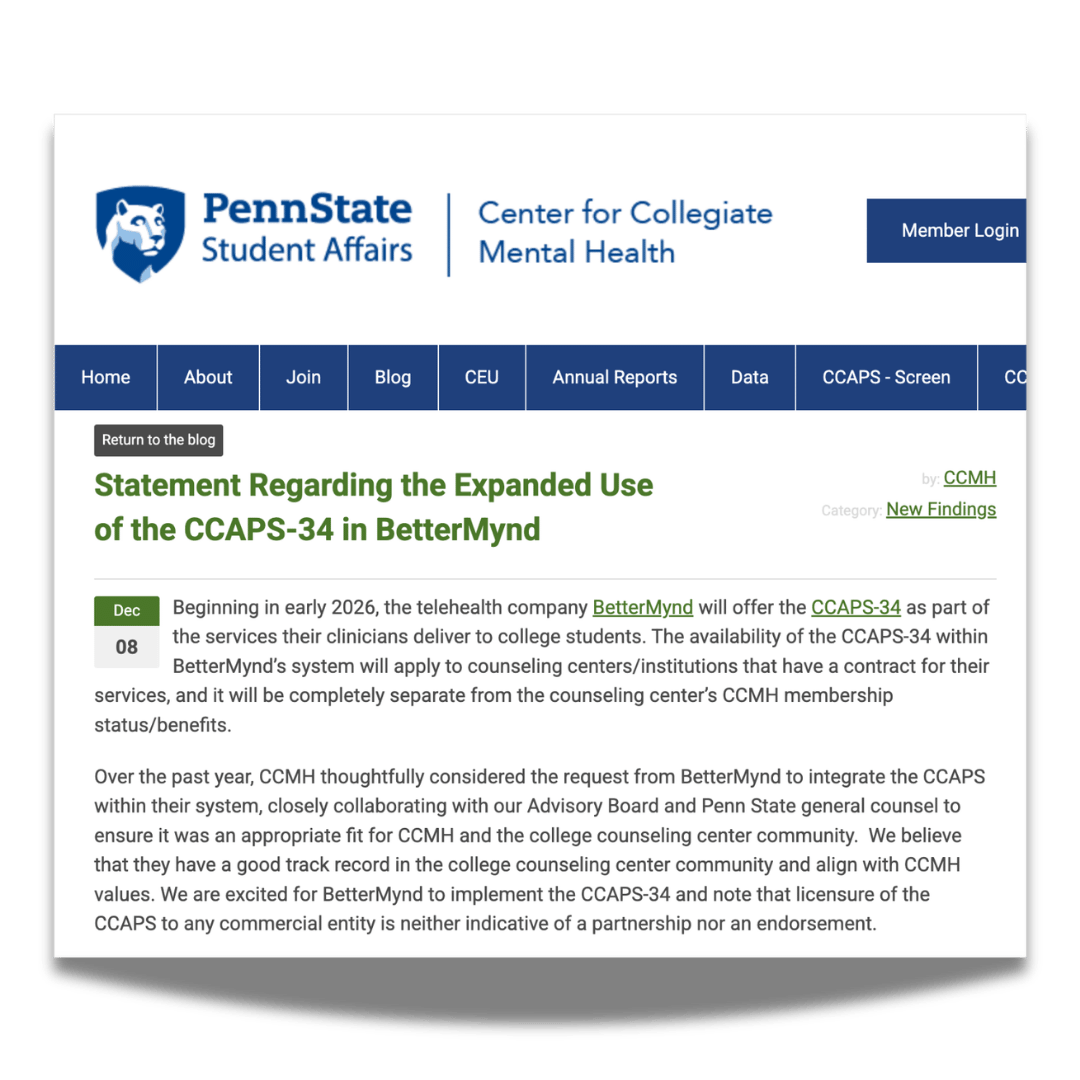
It also matters because licensing the CCAPS-34 is not a marketing shortcut. It comes with responsibility: to train clinicians well, to interpret the data appropriately, to communicate clearly with institutional partners, and to be honest about what the instrument can and cannot tell us. CCMH announced the relationship in December 2025, describing it as work that “reinforces the terrific work we have collectively accomplished to advance measurement-based care in our field.

BetterMynd is the only online therapy provider with exclusive licensure of the CCAPS-34. Through this license, BetterMynd can offer the CCAPS-34 as part of the services our clinicians deliver to students at contracted partner institutions. Every BetterMynd clinician using the instrument is trained in its administration and interpretation. The purpose is not simply to add an assessment at intake. The purpose is to make measurement-based care more consistent with the practices campus counseling centers already use.

For partner institutions, this creates a more useful basis for understanding student need across settings. Counseling centers and institutional leaders can look at aggregate patterns among students using BetterMynd and interpret those patterns through a familiar college mental health framework.

That does not make online care the same as campus-based care. It does make the connection between the two clearer.

And for those of us working on the private-sector side of student mental health, that clarity should raise the standard for what we are willing to show, explain, and be accountable for.

What this changes — and what it does not

I want to be careful not to overstate what shared measurement can solve.

Using the CCAPS-34 creates a common assessment language between BetterMynd and campus counseling centers. It can support smoother referrals, clearer consultation, and more useful aggregate reporting. It can help institutions better understand the clinical profile of students using online therapy, including students who may not otherwise have accessed care through the counseling center.

That is a meaningful change — and an accountability mechanism.  If we are using the field’s assessment language, then we should be prepared to answer the field’s questions.

Those are meaningful changes, but they are not the whole answer.

Student-level information still requires appropriate consent. That is not a barrier to work around; it is a necessary boundary. A student’s privacy and agency have to remain central, even when systems are trying to coordinate care more effectively.

Online therapy is also not the right level of care for every student. Campus counseling centers continue to play a critical role in crisis response, in-person assessment, coordination with campus partners, and support for students whose needs exceed what scheduled outpatient teletherapy can provide.

And measurement alignment, by itself, does not create continuity. Handoff protocols matter. Communication pathways matter. Clear expectations between the counseling center and the external partner matter. Relationships between clinical teams matter.

The CCAPS-34 can make those conversations more concrete, but it cannot replace them. 

It is also important to say what the CCAPS does and does not measure. It gives us clinically meaningful information about psychological symptoms and distress. It does not, by itself, tell us everything we may want to know about belonging, persistence, retention, academic progress, or the broader student experience. Those questions require additional measures and additional collaboration.

What I ask of my peers — and of my own team

Before joining BetterMynd, I spent about eighteen years in mental health and human services, including ten years in college counseling centers. For the last few years, I have worked from the private-sector side with an organization designed to supplement and at times, complement, campus counseling centers for the reasons institutions know well: access, flexibility, out-of-state students, provider diversity, evening and weekend availability, and the reality that many students prefer or need to attend sessions from home.

I have also seen the advantages the private sector can bring when it is working responsibly. External partners can often move faster, dedicate different kinds of operational and technical resources, and respond to implementation challenges with fewer layers of institutional red tape. That can be useful to campuses trying to meet student need in real time. But usefulness is not the same as trustworthiness. The standard has to be higher than whether a service can be launched quickly or used easily.

The questions I had on the counseling center side are still the questions I carry now, just from a different seat.

What does a campus need to know in order to trust an external partner? What information is clinically meaningful rather than merely marketable? What should we be willing to measure, report, and be held accountable for?

“Utilization gets treated as outcome. Access gets treated as continuity. Satisfaction gets treated as clinical improvement. Proprietary dashboards can make a service look measurable without making it meaningfully accountable.”

What private-sector partners owe the field

From that perspective, I think private-sector partners in student mental health owe the field a few things, and they are connected.

The most important one is that we should build on what already exists. College counseling has developed research, assessment tools, professional standards, and clinical wisdom over decades. Reinventing that work in favor of a proprietary approach is rarely better for students or institutions, and usually it is just easier on the vendor.

Building on that work means being transparent about methodology and about limits — if we say something is working, we should be able to show how we know, and if there are limits to what the data can tell us, we should say so clearly. Responsible measurement includes restraint.

That matters because the field has seen too many claims presented with more confidence than the underlying method can support. Utilization gets treated as outcome. Access gets treated as continuity. Satisfaction gets treated as clinical improvement. Proprietary dashboards can make a service look measurable without making it meaningfully accountable. Those distinctions shape how institutions understand student need, how they allocate limited resources, and how they explain to students and families what kind of care is actually being provided.

All of which is to say that private-sector partners should be accountable to the standards of the field we serve. If counseling centers are expected to examine outcomes, assess need, and make evidence-informed decisions under real operational constraints, their partners should not be held to a lower one. That means being willing to say what our tools measure and what they do not, not overstating the relationship between engagement and clinical change, and not asking institutions to accept a vendor-defined version of success when the field already has stronger ways to evaluate student distress, treatment response, and care quality.

It also means vendor partners need to be in the conversation, not adjacent to it. For a long time, it made sense for college counseling to be cautious about private-sector involvement. The field had good reasons to protect its standards, its students, and its clinical judgment. But external partners are now part of the student mental health ecosystem in a more established way. Calling vendors into the conversation is not the same as giving them a pass. It is a way of making sure they are working within the expectations, language, and accountability structures the field has already built.

None of this is especially radical. It is what college counseling has asked of itself for a long time.

The question is why private-sector partners should be exempt from the same expectations.

I do not think we should be. And I do not think the next phase of this work should be about keeping vendors outside the room until something goes wrong. It should be about inviting the right partners into the room earlier, with clearer expectations about evidence, clinical scope, data use, student privacy, and shared responsibility.

There is more to figure out.
Speed is not the same as integrity

The private-sector role in student mental health is real, and it’s real precisely because we can do some things campuses can’t do quickly. We can adapt schedules and provider networks. We can move through fewer procedural layers. We can meet students who would otherwise wait, or who live across a state line, or who never walk into the counseling center.

Those advantages are why colleges turn to external partners. They are not substitutes for clinical integrity. If anything, the speed makes the obligation greater — to measure carefully, to communicate honestly, and to be specific about what any one model can responsibly provide.

That is what shared measurement makes possible. The rest is up to how seriously we choose to use it.

About the author

Kate Wolfe-Lyga, LMHC, ACS, is Vice President of Clinical Operations at BetterMynd, the only online therapy provider with exclusive licensure of the CCAPS-34. She has more than twenty years of experience in mental health and human services, including 10 years in college counseling centers, 7 years as Director of the Counseling Services Center at SUNY Oswego, and previously served on the board of the Association for University and College Counseling Center Directors (AUCCCD).

FAQ

A: The CCAPS-34 is a 34-item clinical assessment developed by the Center for Collegiate Mental Health (CCMH) at Penn State. It measures seven dimensions of distress and is used by 850+ college counseling centers nationally.

A: Without shared assessment, counseling centers can’t track whether students receiving online care are experiencing the clinical change they need. Shared measurement creates continuity between campus and external care.

A: BetterMynd is the only online therapy provider with exclusive licensure of the CCAPS-34. Every BetterMynd student is assessed with the same instrument used in campus counseling centers, enabling shared clinical measurement.

A: Shared measurement does not replace in-person crisis care, cross all consent boundaries for student-level data, or address outcomes beyond clinical distress such as belonging and retention.

Extending What Works

At BetterMynd, our adoption of the CCAPS-34 is rooted in a direct conviction: the standards counseling centers have developed over decades should be extended as care expands beyond the campus walls, not replaced with instruments that serve vendor interests. Shared assessment is how we ensure that teletherapy strengthens the institutional ecosystem rather than fragmenting it. We are working toward an expanded national standard of care — inclusive of the online therapy partner — and aligned assessment is imperative to getting there.

The students who never show up on your counseling center waitlist are still your students. They are entitled to care that is accountable, visible, and held to the same standards your institution has already established.

What becomes possible when every care setting speaks the same clinical language?

If that question matters to your institution, we’d like to be part of answering it.

→ Schedule a conversation with our partnerships team