2025-26 STUDENT SURVEY
2025-26 STUDENT SURVEY
Most of what we know about why students do or don’t engage in mental health care comes from the students who didn’t engage.
Surveys of help-seeking behavior, studies of campus counseling utilization, research on barriers to access — they almost always look at the students at the edges: the ones who never came in, never followed up, never returned, or the ones who did and stayed. We know a lot about students who don’t get care, and a fair amount about the ones who get it on campus.
What we know less about are the students in the middle — the ones who did look for help, just not from their campus counseling center. They don’t show up cleanly in either picture. That’s the population this year’s BetterMynd Student Survey reached.
Of the 595 students who completed at least one counseling session through BetterMynd in 2025–26, 84% had tried something else first — off-campus therapy, peer support, a hotline. What most of them hadn’t done was turn to the campus counseling center.
That changes who the hidden student is. We tend to picture them as new to seeking help — too uncertain or too unaware to reach out. But these students knew how to ask. They’d done it before. The hidden student isn’t only the first-time help-seeker; it’s any student the counseling center isn’t reaching — including the ones who’ve looked for help everywhere but there.
Three findings from their experience stood out.
Across every discussion of barriers to college mental health care, the assumption is that the main obstacle is awareness — students don’t know what’s available, or they don’t feel comfortable seeking it out. The 2025-26 data complicates that picture.
When we asked students how they first learned about BetterMynd, the campus counseling center was the second most common answer. Nearly one in four students — 24% — found their way to BetterMynd through their UCC. Now compare that to a related question: if BetterMynd hadn’t been available, what would they have done? Only 16% said they would have gone to the campus counseling center on their own.
Look at those two numbers side by side. More students reach BetterMynd through their counseling center than would have walked into the counseling center themselves. The act of being referred — having someone the student already trusts say “try this” — is doing work that no marketing campaign, awareness drive, or self-service portal can replicate.
Look closer at the 142 students who arrived through their counseling center and the pattern sharpens. More than half (52%) had already tried off-campus counseling. Four in ten had tried on-campus counseling before this referral. These weren’t students stumbling onto a service. They were students whose counselors knew their care needs and made a deliberate hand-off — and half of them said they would have done nothing or weren’t sure what they would have done if there hadn’t been a clear next step.
Mental health has a complex history with the practice of the “warm hand-off” – something that primary care has used for years. The 2025-26 data suggests it’s the single most predictive factor in whether a student stays engaged with care. Awareness gets a student to the front door. A trusted hand-off gets them through it.
What this means for campuses: the design problem isn’t only how to make services more visible. It’s how to build the connective tissue between services — between the counseling center and what comes next when the counselor has maxed out their caseload, between the front desk and the student who shows up exactly once, between the first conversation and the second. The 24% / 16% gap is what happens when that connective tissue exists. That gap is the thing worth working on.
There’s a common assumption in mental health policy: if a student has accessed care before, they know how to access it again. They’ve cleared the first barriers — they understand insurance, or they know the counselor’s name, or they’ve been told what therapy feels like. The next time they need help, they’ll find it.
The 2025-26 data suggests this isn’t true.
Two-thirds of BetterMynd students (67%) had tried off-campus counseling before. One in three (34%) had used their campus counseling center. Nearly one in five (17%) had tried both. These were students with care histories — students who knew what therapy looked like and had at least one previous experience of seeking it out.
And yet 51% of all BetterMynd registrants — including students with extensive prior care — said they would have done nothing or weren’t sure what they would have done if BetterMynd hadn’t been available.
Half of them. Even with prior care experience, half would have stalled.
This is worth sitting with. It means the policy lever of “increase access” is not the same as the policy lever of “increase use.” Having navigated care before doesn’t inoculate a student against falling out of it — experienced and first-time help-seekers are both at risk of disengaging. Knowing how to find help is not the same as reaching for it the next time you need it.
It also points to a group the research doesn’t see clearly. Studies of campus counseling utilization look at the students who came in. Research on barriers to access looks at the students who never did. But a student can carry a full care history — therapy, a support line, a counselor’s name still in their phone — and still not be reached by the resources on their own campus. They don’t show up cleanly in either picture.
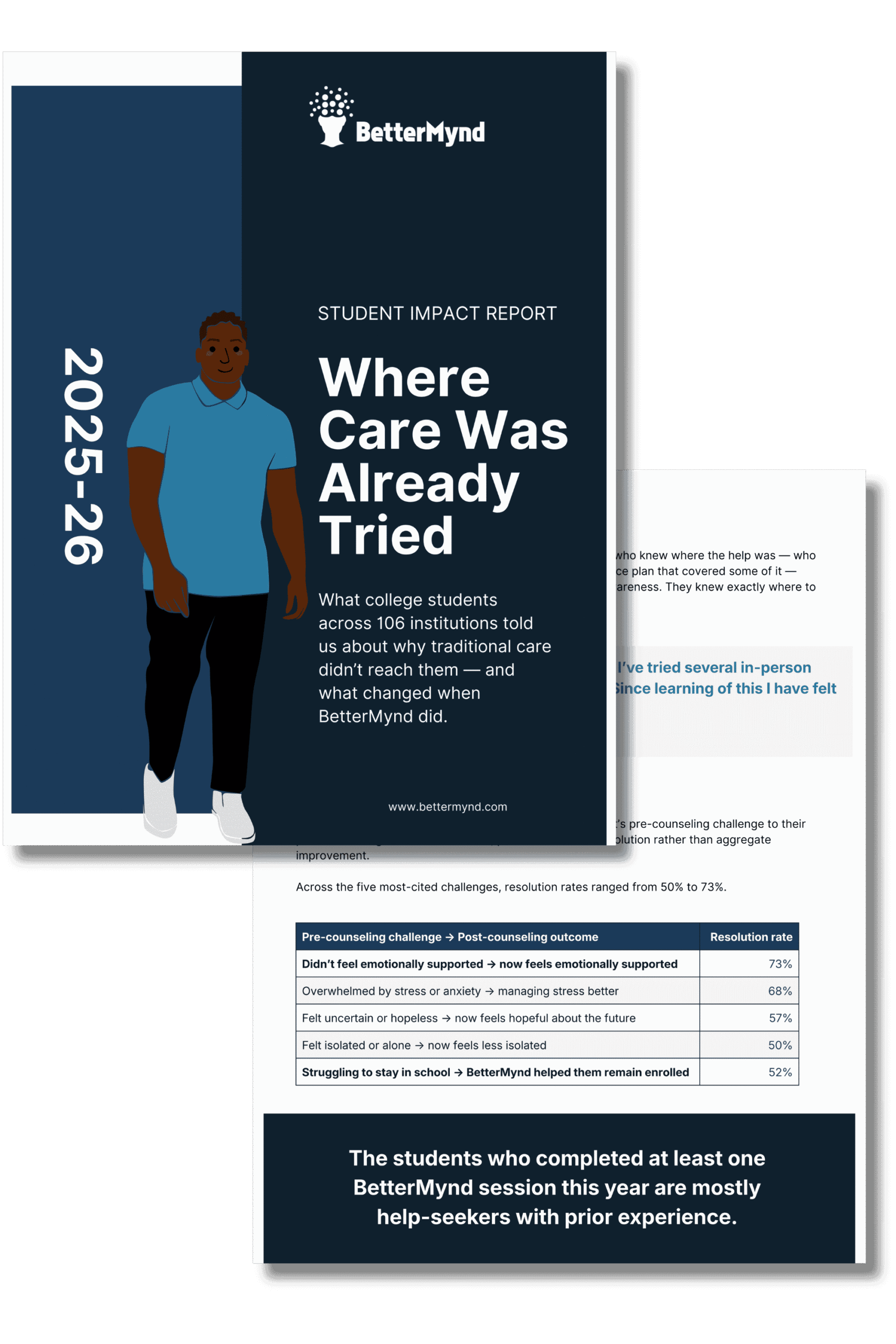
The BetterMynd data captures this group — students who’d sought help before and could easily have disengaged again — and shows what happens when care meets them where they are. Across the five most-cited challenges in this year’s survey, resolution rates ranged from 50% to 73%. These are paired measures: the share of students who reported a specific challenge before counseling and who reported the corresponding improvement after.
These aren’t aggregate gains. They’re the specific students who selected a challenge upfront and then selected the matching improvement at the end. For students who had tried care before and stopped, this is what “it worked” looks like — and 21% of all 595 respondents said the care helped them remain in school, suggesting that persistence and clinical outcomes are deeply intertwined.
What this means for campuses: the hidden student isn’t only the student who’s never asked for help. A large share of the students the counseling center isn’t reaching already know how to ask — they’ve done it before, just somewhere other than campus. That’s not a reluctance problem, and it doesn’t get solved by lowering the barrier to a first attempt. When these students land in care that fits their needs, they report outcomes as strong as any first-time success. So the question isn’t only how to support a hesitant student through the door for the first time — it’s also how to meet the students who are clearly willing to seek help, but aren’t turning to the counseling center, where they are.
Among the students in the survey, two patterns separate care that produces outcomes from care that doesn’t. They are unsurprising in concept but underutilized in practice.
The first is fit. A student who finds a counselor whose schedule works, whose identity feels safe, whose language they can think clearly in, and whose specialty matches what they came to talk about is meaningfully more likely to come back for a second session. The 2025-26 data lets us look at how often students experience each of those dimensions of fit as easy.
Two of these dimensions deserve particular attention from anyone designing campus mental health systems. Identity match and language match are the dimensions where traditional campus counseling most often struggles. A typical campus counseling center serves a student body of thousands with a clinical staff of a few dozen — making it structurally difficult to offer a counselor who shares any given student’s background, language, or identity within a reasonable timeframe.
This is not a critique of campus counseling staffing. It’s a design observation. The students who most need to see someone who looks like them, speaks like them, or understands their cultural context are the same students who are most likely the hardest to engage without those needs being met — and they are the most difficult students for an in-house team to reach. The lesson from the data is that meeting that need at scale takes a network, not a single office.
Fit, though, is only half the story. The other half is whether the care continues long enough to do its work.
Mental health care isn’t supposed to last forever. It’s supposed to last until the student has what they came for. So the most important metric of care quality isn’t how long students stayed in care — it’s why they stopped.
Of the 373 students who had stopped meeting with their counselor this year, 28% said they stopped because they had met their goal or the concern that brought them to counseling was resolved. Another 37% of all respondents hadn’t stopped at all — they were still actively in care at the time of the survey.
Combined, 55% of all BetterMynd registrants were either still in active care or had completed care because they had met their goal. That’s a measure of care that maintains engagement — care that doesn’t churn, doesn’t drop off, doesn’t lose students in the middle.
This is the metric we’d argue campus mental health leaders should value understanding more than session counts or registration totals. Goal completion is the clinical equivalent of graduation — it’s the outcome the service exists to produce. Counting it directly tells you something registration data can’t.
The two findings — fit at the start and completion at the end — aren’t independent. Students who find care that fits at the start are the same students who stay in it long enough to finish. The 73% emotional support resolution rate, the 68% stress resolution rate, the 52% retention rate from the previous section all depend on both conditions being met. Without fit, the second session doesn’t happen. Without completion, the outcomes don’t have time to develop.
What this means for campuses: when evaluating any mental health service — in-house, contracted, or hybrid — the question isn’t how many students used it. It’s whether students could find care that fit them, and whether they stayed in that care long enough to finish what they came for. Those two metrics, taken together, predict everything else.
Three findings from 595 students, one through-line: college mental health care works when the path between the student and the right counselor is trusted, swift, and continuous.
Trusted, because the most reliable way to get a student into care is a hand-off from someone they already know — a counseling center referral, a faculty member who knows them, an advisor they trust. Awareness gets students to the door; trust gets them through it.
Swift, because students who have tried care before and stopped don’t have unlimited patience for another false start. If the second attempt doesn’t fit on the first try — wrong counselor, wrong schedule, wrong language — most students will not try a third time.
Continuous, because care that fits at the start is only valuable if it continues long enough to produce outcomes. The students who report the strongest improvements are the students who stayed in care until the work was done.
BetterMynd has the data to surface these findings because we work with this population at scale — students who have tried things, who have started and stopped, who are looking for the option that finally works. We’re sharing what we’ve learned because the lessons apply far beyond any one platform: they describe what college mental health systems should be designed to produce, regardless of who is delivering the care.
A: The survey asked 595 students across 106 partner campuses about their challenges before counseling, the outcomes they experienced after, what they had tried before BetterMynd, and what they would have done if BetterMynd hadn’t been available. It also asked how they first heard about BetterMynd and why they stopped meeting with their counselor, if they had.
A: Counseling centers were the second-largest discovery channel for BetterMynd this year, sending 24% of registrants — and they referred at a higher rate than students would have walked into the counseling center on their own. Half of the students who arrived through a counseling center referral said they would have done nothing or were unsure what they would have done otherwise. The finding suggests that referrals from trusted campus sources are doing engagement work that awareness campaigns and self-service portals can’t replicate.
A: 84% of BetterMynd students had used some form of prior mental health support — campus counseling, off-campus therapy, peer support, or hotlines. Two-thirds had tried off-campus counseling. One in three had tried on-campus counseling. Nearly one in five had tried both. Despite that prior experience, 51% said they would have done nothing or weren’t sure what they would have done without BetterMynd. Prior care does not predict future engagement.
A: Resolution rates are paired measures: the share of students who selected a specific challenge before counseling AND selected the corresponding improvement after. They count only students whose direction of change can be observed for a specific dimension. Across the five most-cited challenges, resolution rates ranged from 50% to 73%.
A: Fit refers to whether a student finds a counselor whose schedule, language, identity, and specialty match what they need. Students rated each dimension of fit as easy: booking (88%), preferred language (90%), counselor availability (80%), identity match (79%), and specialty match (78%). Identity and language match are particularly important — they’re the dimensions traditional campus counseling staffing is structurally hardest to deliver at scale.
A: Mental health care is supposed to last until the student has what they came for, not forever. 28% of students who stopped meeting with their counselor this year did so because they met their goal — the clinical equivalent of finishing the work. Another 37% of all respondents were still actively in care. Together, 55% of registrants were either still in care or completed care successfully — a measure of whether care holds long enough to produce outcomes.
A: Three implications: (1) Invest in the connective tissue between services. Warm hand-offs from trusted campus sources outperform awareness campaigns. (2) Treat students who have tried care before as a distinct population, not a less urgent one — they need the second attempt to fit on the first try. (3) Measure goal completion, not just registration. Whether care holds is the metric that predicts whether outcomes happen.
CONTACT BETTERMYND
BetterMynd’s mission is to help every campus meet individualized student mental health needs through a service-first, sustainable partnership.


About BetterMynd
Through our network of providers and the power of teletherapy, BetterMynd is empowering college students to get the mental health care they need.
BetterMynd is not an emergency service and should not be used by anyone experiencing a life-threatening or crisis situation. Instead, you should call 911 to get immediate assistance.
BetterMynd
Additional Info
© 2026 BetterMynd, All Rights Reserved.